
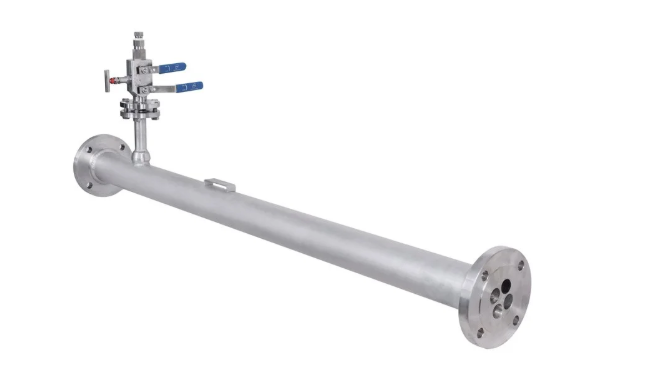

Industrial fluid mixing needs to produce consistent results without unnecessarily increasing energy consumption, equipment size or operating complexity. When two or more fluids need to be combined within a process line, the mixing equipment must create sufficient turbulence and contact between the streams. An inline arrangement can achieve this within a compact footprint while allowing the process to continue through a continuous pipeline. Its effectiveness depends on factors such as flow rate, viscosity, pressure, temperature, fluid compatibility and pipe dimensions. Proper design is therefore essential to achieve uniform mixing while keeping pressure loss within acceptable process limits.
What Is an Inline Static Mixer?
An inline static mixer is a fixed mixing device installed directly inside a process pipeline. Unlike conventional agitators, it has no motor, rotating shaft or external drive mechanism.
As fluid moves through the pipeline, specially shaped internal elements divide, redirect and recombine the flowing streams. This creates repeated changes in velocity and flow direction, encouraging the materials to blend as they travel through the mixer.
The absence of moving parts can simplify operation and maintenance. However, the mixer must be correctly selected because its internal geometry determines how effectively the available flow energy is converted into mixing.
Start With the Mixing Objective
Before selecting a mixer design, engineers need to define what the process is expected to achieve.
The application may require:
- Blending two liquids
- Dispersing one fluid into another
- Diluting a chemical
- Maintaining concentration uniformity
- Adjusting pH through chemical addition
- Combining additives with a primary process stream
- Improving heat transfer between fluids
- Preparing a consistent feed for downstream equipment
These applications do not necessarily require the same mixer configuration. A low-viscosity liquid blend may need a different internal arrangement from a high-viscosity process or a system involving rapid chemical reactions.
The required degree of uniformity should also be established. Mixing specifications can be based on concentration variation, residence distance, dispersion quality or another process-specific measurement.
Flow Rate and Velocity Matter
- Flow conditions directly affect static mixer performance.
- Insufficient velocity may reduce turbulence and mixing effectiveness.
- Higher velocity can increase pressure loss, energy consumption and mechanical loading.
- Evaluate minimum, normal and maximum flow conditions.
- For multiple streams, consider the ratio between the main and secondary flows.
- Large flow differences can affect material distribution within the pipeline.
Consider Fluid Properties
- Density, viscosity, temperature and composition influence mixing performance.
- Highly viscous fluids may require greater pressure and mixing energy.
- Temperature changes can affect viscosity and density.
- Assess the mixer across relevant operating and design conditions.
- For chemical applications, ensure all wetted materials are compatible with the process fluid.
Understand Mixer Element Geometry
Internal element geometry controls how the material is divided and recombined, affecting mixing intensity and pressure requirements. The right configuration depends on the mixing duty and flow conditions. Adding more elements can improve mixing but may also increase pressure loss. Similar to an orifice plate flow meter, the surrounding flow conditions should be considered carefully, especially when the mixer is installed near other process equipment.
Balance Mixing Quality With Pressure Loss
Mixing performance should be balanced against pressure drop. Stronger turbulence can improve blending but may increase energy consumption and reduce pressure available to downstream equipment. The mixer should therefore be assessed as part of the complete hydraulic system.
Account for Pipe Size and Installation Space
Pipe diameter, connection type, flange rating and available installation space should be considered when selecting a mixer. The design should prevent bypass flow and allow adequate space for installation, inspection and maintenance.
Mixing Multiple Streams
For processes involving additives or chemicals, injection location is important. The secondary stream needs suitable flow conditions and enough downstream distance for effective distribution. Poor injection positioning can lead to uneven mixing and chemical waste.
Chemical and Water Treatment Applications
Static mixers can provide consistent blending of treatment chemicals without a separate mixing tank. Design considerations include chemical concentration, injection rate, contact time and material compatibility. The mixer should achieve uniformity without excessive pressure loss.
Integration With Flow Measurement
Mixers, pumps, valves and flow meters should be positioned carefully to avoid unwanted turbulence and disturbed flow profiles. Required straight lengths and manufacturer recommendations should be included during piping design. For an orifice plate flow meter, suitable upstream and downstream conditions are particularly important for reliable differential-pressure measurement.
Common Design Mistakes to Avoid
Several design issues can reduce the effectiveness of an inline mixing system.
Choosing equipment only by pipe diameter: The mixer must also match flow rate, viscosity and the required mixing duty.
Ignoring pressure loss: Strong mixing does not automatically mean good process design if the resulting pressure requirement is excessive.
Using incomplete fluid data: Changes in viscosity, density or temperature can affect performance.
Poor injection positioning: A secondary stream may not distribute properly if introduced at an unsuitable location.
Overlooking maintenance requirements: Compact installation should not make inspection or removal unnecessarily difficult.
Ignoring the complete piping system: Nearby bends, valves and restrictions can influence flow entering the mixer.
Why Process-Specific Design Is Important
There is no universal mixer configuration for every industrial process. The right arrangement depends on the materials, required mixing quality, flow conditions, available pressure and pipeline configuration. A process-focused approach evaluates these factors together to avoid oversizing, excessive pressure loss and unsuitable internal geometry.
Conclusion
Efficient industrial mixing depends on achieving the right combination of flow conditions, internal geometry, fluid compatibility and pressure management. A static arrangement can provide continuous blending without the rotating machinery associated with conventional agitators, but its performance still depends heavily on correct engineering. Pipe size, viscosity, flow range, injection method, pressure loss and installation conditions should all be assessed before final selection. A properly designed system can support consistent mixing while fitting naturally into the wider process line. NND OIL & GAS can support industrial projects requiring engineered process equipment and application-specific manufacturing.